NNN Development Template
Land-driven development with lot-level NNN ground lease income and partial or full land sale toggle.
A monthly cash-flow model for land-driven development strategies. Underwrite land acquisition, lot-level NNN ground lease income, partial or full land sales, development costs, financing, and investor returns in one workbook. Designed for the long-hold NNN play, with a 20-year default horizon and 24+ years of monthly cash flow.
Why This Template
NNN land-driven deals run on two different liquidity structures at once: straight land or pad sales, and NNN lease development held for income. The model carries both in one workbook and lets you move between them on the fly. When a negotiation shifts from a pad sale to a ground lease and back, you re-toggle the lots and the returns update live, fast enough to answer on the call. It stays intuitive while doing a lot: lot-level lease and sale timing, debt sized on improvements, refinance, and a Gross Exit that adds the operating cap value to the land sales. Things get more layered when the ground lease has CPI-linked escalators that compound differently across lots, or when the partial land sales trigger pre-payment penalties on the construction loan that haven't burned off yet.
What This Model Does
Start with a land acquisition. Define the lot-level lease and sale plan. Layer in development costs. The model flows everything through:
- Income (recurring NNN lease income, escalated by lot)
- Development costs (lot-level hard costs, project-level soft costs, contingency, landlord contributions, developer fee)
- Land sale proceeds (partial or full, timed by lot)
- Capital events
- Debt (initial loan sized only on improvements per institutional convention, interest reserve, refinance, interest-only or amortizing, sized on LTV or DSCR)
- Investor returns (waterfall, preferred return, tiered promote, configurable GP / LP splits, IRR, MoC, profit)
Core Capabilities
Land Acquisition and Development Strategy
NNN dev is a long-hold play. Value compounds in recurring ground lease rent over 10 to 20 years, not 5, and the long-tail NOI growth is where the deal pays off. The exit cap math only reads right when the model runs long enough to show it, so this template defaults to a 240-month hold and runs 24+ years of monthly cash flow.
- Land purchase price and basis
- Hold period and exit timing
- Lot-level development plan
- Recurring NNN lease income
- Partial or full land sale proceeds
Lot-Level Ground Lease and Land Sale Modeling
Each lot is modeled on its own rather than blended into a single assumption. The template scales from a few lots to a dozen without changing how it works.
- Lot size by parcel
- NNN lease start timing
- NNN rent PSF and annual rent
- Rent escalation assumptions
- Land sale dates
- Land sale value PSF and total sale proceeds
Capital Structure for NNN Development
Land LTC defaults to 0%, All Other Uses LTC to the lender's input. An Equity First (1) / Pari Passu (0) toggle lets you model how equity and debt fund into the deal.
Exit Value from Two Income Streams
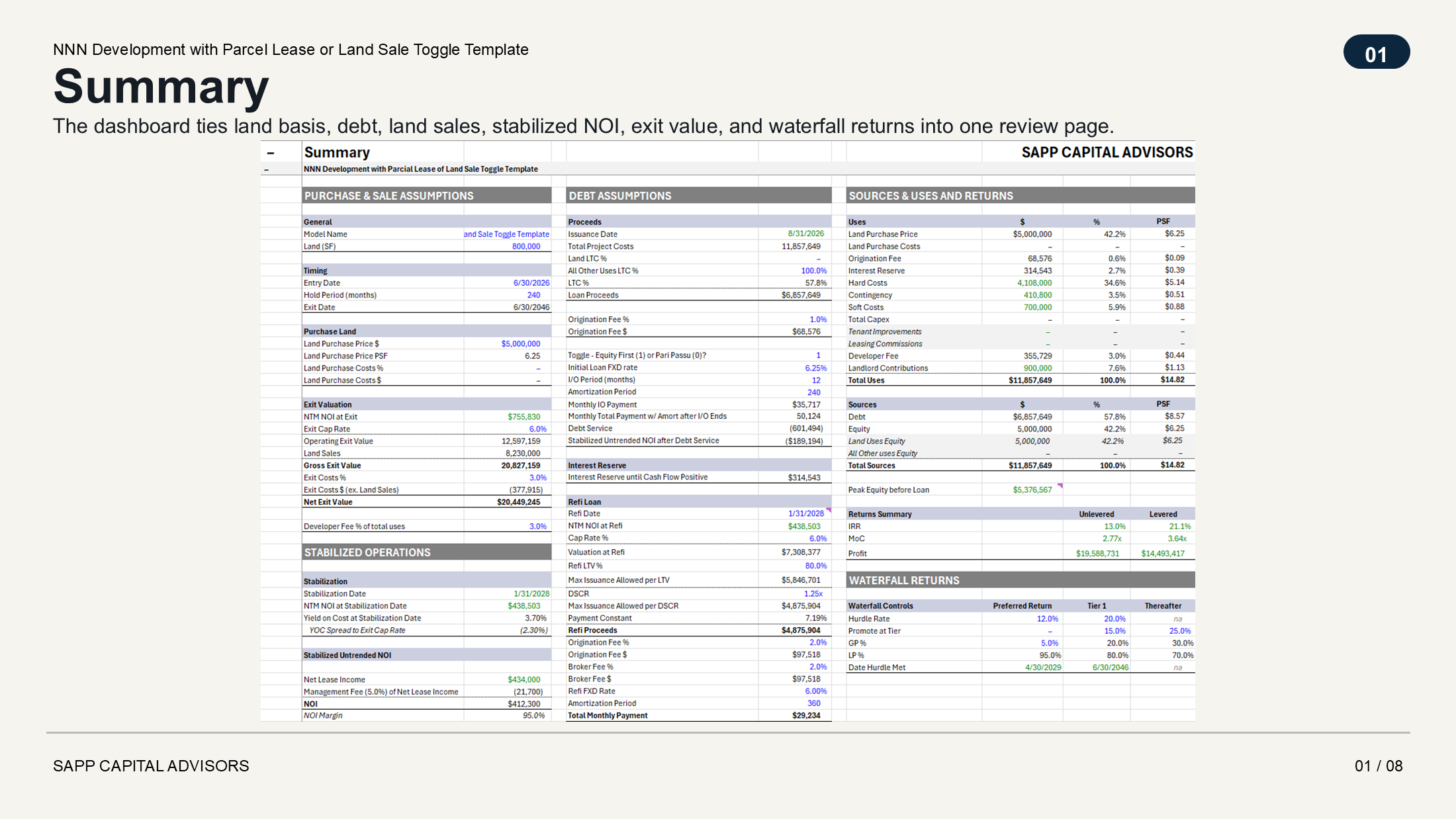
Value comes from two different income streams: recurring ground lease rent that builds the operating cap value, and one-time partial land sale proceeds. Both belong on the exit page, so the template adds them as Gross Exit Value = Operating Exit Value + Land Sales, with the build shown on the Summary.
Development Costs with Timing
Costs are tied to the project timeline, not floated as bulk inputs. Developer fee is its own line item because it's real cash to the GP. Burying it in soft costs hides the GP's take and shifts the LP returns calc.
- Lot-level hard costs
- Project-level soft costs
- Contingency
- Landlord contributions
- Developer fee (% of total uses) as a line item, not buried
- CapEx timing hits the monthly cash flow directly
Stabilized Operations
The lease plan translates into project-level operating performance with the NNN convention: Management Fee at 5% of Net Lease Income (not % of EGI, which is multifamily math).
- Net lease income
- Management fee (5% of NLI per NNN convention)
- Stabilized untrended NOI
- NOI margin
- Yield on cost
- Spread to exit cap rate
Integrated Monthly Cash Flow
Every assumption flows through a single monthly model.
- Full Sources and Uses
- Land purchase and closing costs rolled into total basis
- Development costs and landlord contributions
- Recurring lease income
- Land sale proceeds
- Debt and equity funding
- Refinance proceeds
- Exit
Debt, Refinance, and Exit
Refinance modeling carries the same input richness as the initial loan. Sized as conservative of LTV and DSCR.
- Initial loan sized on improvements (Land LTC default 0%)
- Interest reserve
- Interest-only or amortizing
- Refinance with full LTV, DSCR, fixed rate, amortization, origination fee, broker fee
- Sized as conservative of LTV or DSCR
- Exit on forward NOI, exit cap rate, and land sale proceeds
Built for Audit
Pure Excel. No macros, no VBA, no dynamic-array surprises. Every formula traces via Excel's precedents and dependents. The IC analyst on the buy-side can audit the model without calling us.
- Global Checks sheet aggregates per-sheet local checks.
- The model enforces our underwriting principle on every refresh: all negative levered cash flows reconcile to equity contributions.
- NTM Period Ends After Exit check fires when the exit date sits too close to the right edge of the projection for the forward NOI window to populate. This is the failure mode that breaks long-hold NNN models, and the check catches it.
- Built-in Change Log captures the WHY behind each assumption change.
- Color conventions consistent across the library.
- Print areas defined on every sheet.
Print-Ready Dashboard
The Summary sheet is built as an IC-style dashboard. Assumptions, Sources and Uses, stabilized operations, financing, waterfall, and deal outputs in a presentation-ready layout. Every other sheet prints clean too.
What It's Designed For
- NNN development strategies
- Ground lease projects
- Land acquisition with partial land sales
- Lot-by-lot lease and sale strategies
- Projects where value is created through both recurring income and land monetization
- Analysts, investors, and teams underwriting land-driven deals in Excel
What It's Not
- Not a traditional multifamily development model
- Not a stabilized acquisition model
- Not a detailed vertical construction budget tool
- Not dependent on macros or complex systems
For cross-template conventions (color coding, check system, change log), see Modeling Standards →.
Use this on your next deal