Multifamily Development Template
Ground-up multifamily development, from construction draws through lease-up to stabilized returns.
A monthly cash-flow model for ground-up multifamily development, from construction draws through lease-up to stabilized returns. Construction loan logic with interest reserve auto-sized until cash flow positive. Refinance with full input parity to the initial loan. Investor waterfall.
Why This Template
Development models tend to break in the same few places: construction spend curves that don't tie to the loan draw schedule, interest reserves that run dry six months before stabilization, and lease-up assumptions that ramp too fast and flatter the refi numbers. The template is built around the checks that catch each of those before the deal goes to IC. Interest reserve auto-sizes until cash flow positive, the refi sizes as the conservative of LTV and DSCR with full input parity to the initial loan, the Equity First vs Pari Passu toggle lets you model how capital funds in, and Yield on Cost and spread to exit cap sit on the Summary alongside IRR and MoC. Things get more detailed when you have pre-construction spend you want to later collateralize with a loan a few months in, especially if that spend is a sizeable chunk of cost and you're almost doing an equity distribution via the construction or land loan.
What This Model Does
Start with your unit mix and construction plan. Define your operating assumptions. The model flows everything through:
- Construction costs split into pre-loan and post-loan, on separate date controls
- Lease-up and stabilized operations
- Capital events
- Debt (construction loan with interest reserve, refinance, timing-based funding)
- Investor returns (waterfall, preferred return, tiered promote, IRR, MoC, profit, plus Yield on Cost and spread to exit cap)
Core Capabilities
Flexible Draw and Funding Logic
The draw schedule and funding sequence aren't hardcoded. Construction draws, interest reserve, and the timing of equity and debt run off inputs and recompute to the deal in front of you, as precisely as the math allows. When a deal needs something non-standard, the model bends to it.
- Draw logic driven by inputs, not a fixed schedule
- Equity and debt funding sequenced by the Equity First vs Pari Passu toggle
- Pre-loan and post-loan costs on independent date controls
- Pre-construction spend you can collateralize with a loan later in the timeline
Unit Mix to Lease-Up to NOI
Development starts at the unit level, not at a top-line NOI assumption.
- Unit count and mix by type
- Rent assumptions by unit type
- Lease-up timing and absorption
- Transition from in-place to stabilized operations
Construction Modeling with Pre-Loan vs Post-Loan Discipline
Pre-loan costs happen before the construction loan closes. Post-loan costs happen after. The template handles them on separate date controls.
- Pre-loan and post-loan costs with start date, duration, end date
- Pre-loan and post-loan capital deployment modeled correctly
- Construction timeline integrated into monthly cash flow
- Built-in check that post-loan costs start after pre-loan end, a common date-sequence mistake
Capital Structure for Construction
Land LTC and Construction (ex-Land) LTC sized on separate inputs and combined into a blended LTC. An Equity First (1) / Pari Passu (0) toggle lets you model how equity and debt fund into the deal. The structure changes the IRR and the timing of when promote kicks in.
Lease-Up Driven Operations
Operations build dynamically as the asset stabilizes, not as a switch flipped at the C of O date.
- Vacancy and absorption over time
- Rent ramp and stabilization
- Operating expenses and growth
- Stabilized untrended NOI framework
Integrated Monthly Cash Flow
Every assumption hits a single monthly model.
- Full Sources and Uses
- Construction funding and capital flows
- Lease-up driven income
- Operating cash flow
- Exit and proceeds
Debt, Refinance, and Exit
Refinance modeling is as rich as initial loan modeling. The Refi tier carries its own LTV, DSCR, fixed rate, amortization period, origination fee, and broker fee, sized as the conservative of LTV or DSCR.
- Construction loan with interest reserve auto-sized until cash flow positive
- Refinance with full input parity to the initial loan
- Interest reserve circular reference handled cleanly (approved per Sapp rulebook)
- Exit on forward NOI (NTM at exit date) and exit cap rate
- Yield on Cost and spread to exit cap rate as headline returns on the Summary alongside IRR and MoC
Investor Returns and Waterfall
Development performance translated into investor outcomes.
- Unlevered and levered returns
- GP / LP waterfall with Pref + Tier 1 + Thereafter structure
- IRR, MoC, profit
- Sensitivity across key assumptions
Built for Audit
Pure Excel. No macros, no VBA, no dynamic-array surprises. Every formula traces back to its source via Excel's precedents and dependents. The IC analyst on the buy-side can audit the model without calling us.
- Global Checks sheet aggregates per-sheet local checks.
- The model enforces our underwriting principle on every refresh: all negative levered cash flows reconcile to equity contributions. If they don't tie, the check fires before IC tables get built.
- Cumulative debt draws on Cash Flow tie to the debt amount on Sources and Uses, exactly. Sizing logic re-rounds to integer LTC when necessary.
- Built-in Change Log captures the WHY behind each assumption change.
- Color conventions consistent across the library (blue inputs, green cross-sheet links, black formulas).
- Print areas defined on every sheet.
Print-Ready Dashboard
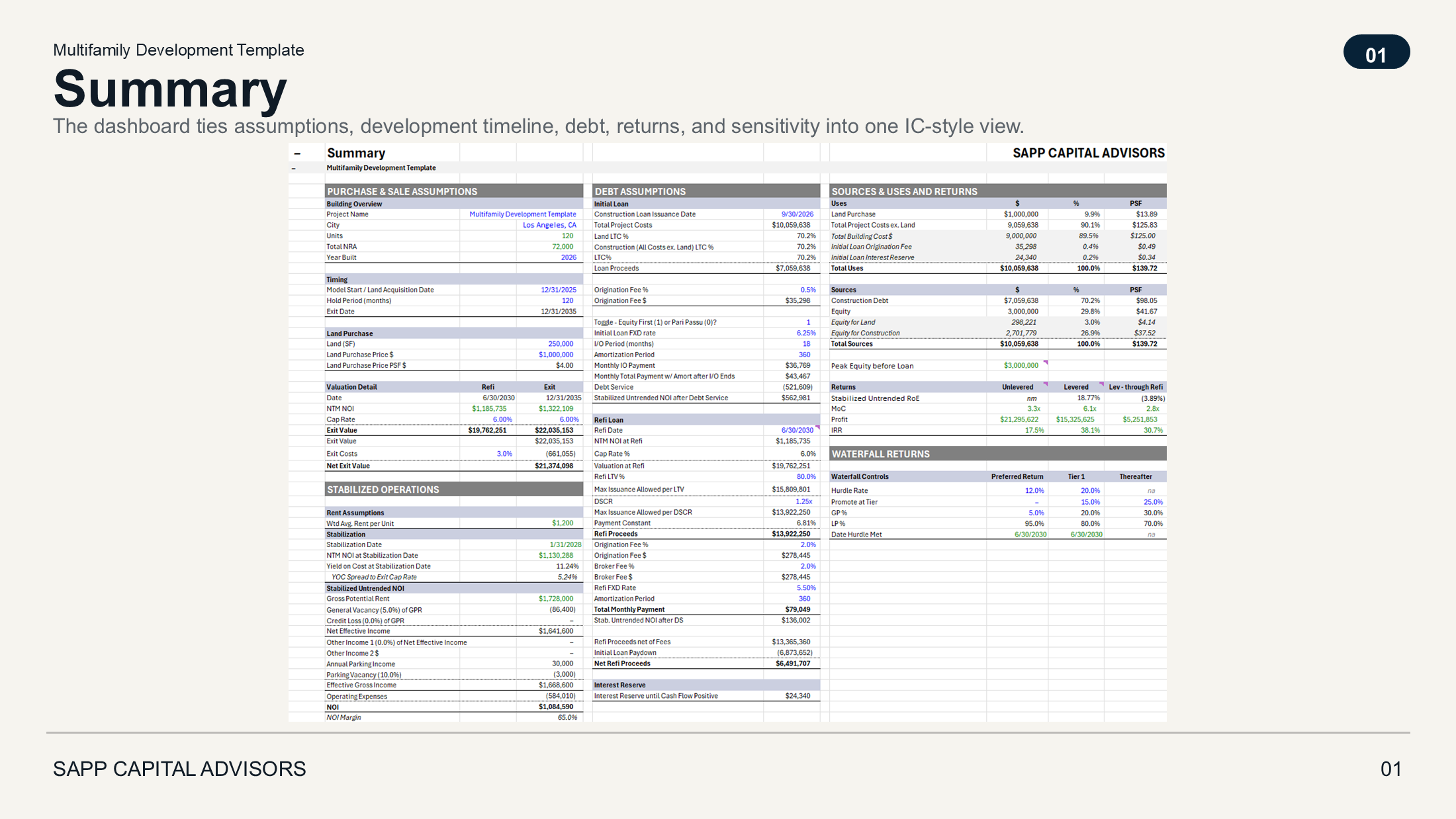
The Summary sheet is built as an IC-style dashboard. Assumptions, development timeline, returns, NTM NOI lookups at refi date, exit date, and stabilization date all in a presentation-ready layout.
What It's Designed For
- Ground-up multifamily development
- Lease-up and stabilization modeling
- Construction plus refinance strategies
- Analysts and investors underwriting development deals in Excel
What It's Not
- Not a stabilized acquisition model
- Not a back-of-envelope tool
- Not dependent on macros or complex systems
For cross-template conventions (color coding, check system, change log), see Modeling Standards →.
Explore Further
Use this on your next deal